| Quick answer |
| Lawyers cannot respond in detail to negative online reviews because of attorney-client confidentiality rules. Disclosing case specifics, even to defend against a false claim, violates professional conduct rules in most jurisdictions. The solution is not silence. It is investing in online reputation management for lawyers. This builds a search presence so strong that the negative review gets pushed off page one, and AI tools like ChatGPT describe the firm accurately based on authoritative signals rather than a single review thread. |
The Story That Changed How One Atlanta Attorney Thinks About Google
David is a personal injury attorney in Atlanta. He has practiced for eleven years, settled hundreds of cases, and built his firm almost entirely on referrals. He has never lost a bar complaint. He has never had a malpractice claim upheld.
In March 2026, however, a former client left a one-star review on Google claiming David had settled their case without permission and kept fees they were owed. Neither allegation was true. In fact, David knew exactly what had happened. He had the emails, the signed settlement authority, and the fee agreement to prove every detail of it.
So he drafted a response. But his bar counsel told him to delete it.
As a result, the review stayed up. It ranked second for his name on Google. Within six weeks, two prospective clients mentioned during intake calls that they had seen something negative online. One of them did not sign.
David’s problem was not that he had done something wrong. His problem was that the rules of his profession prevented him from saying so in public. And that silence was quietly costing him clients.
This is the most common and least understood reputation problem in the legal profession. This article explains why it happens, what the rules actually say, and, more importantly, how online reputation management for lawyers can fix it in 2026.
| 68% of consumers will only use a business with 4 or more stars, up from 55% in 2025. In addition, 31% will only consider a business with 4.5 stars or above, nearly double the 17% threshold from the previous year. |
| 94% of consumers say a negative review has convinced them to avoid a business entirely. |
Why Attorneys Cannot Simply Respond to Negative Reviews
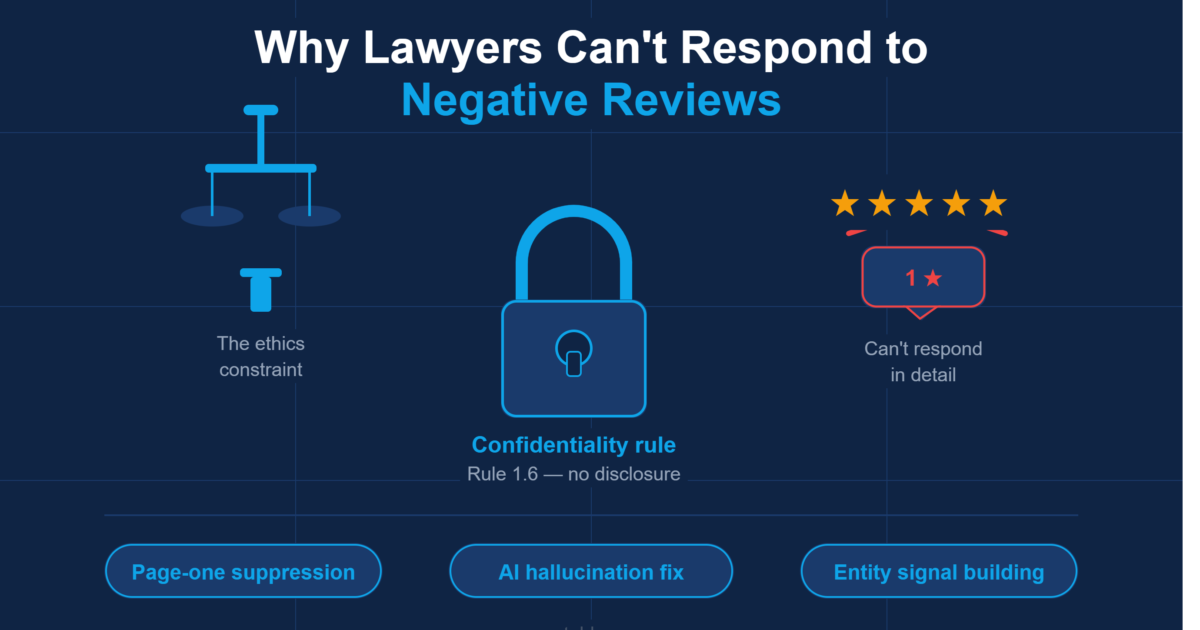
The answer comes down to one word: confidentiality. Every jurisdiction in the United States and most common-law countries imposes a duty on attorneys to protect information relating to the representation of a client. In the US, this obligation is governed by Rule 1.6 of the Model Rules of Professional Conduct, which has been adopted in some form by every state bar.
The core problem with responding to a negative review is that any meaningful defence requires disclosing information about the representation. That includes what happened in the case, what the client was told, and what documents were signed.
All of that information is confidential. As a result, disclosing it without the client’s informed consent, even to correct a false public claim, violates Rule 1.6 in most circumstances.
The Arizona State Bar’s Ethics Opinion EO-19-0010 is the clearest published guidance on this issue. The opinion confirms that an attorney cannot reveal confidential information in response to an online review, and that the fact a client has publicly criticised the attorney does not automatically waive confidentiality.
Beyond that, the recommended response the opinion endorses is deliberately generic: a statement that the attorney’s duty of confidentiality prevents a detailed reply, and that the review does not present a fair picture of events.
That response protects the attorney ethically. It does nothing, however, to protect their reputation commercially. And that gap is exactly where the problem compounds.
| 45% of consumers now use AI tools like ChatGPT to find local business recommendations, up sharply from just 6% in 2025. AI has become the third most popular source of business recommendations, overtaking many traditional review platforms. |
The 2026 Problem: AI Tools Now Read Your Reviews Too
In 2025, a negative review meant one bad result on Google. In 2026, however, it means something considerably more serious.
When a potential client asks ChatGPT or Perplexity about your law firm today, those AI tools do not simply return a list of links. Instead, they generate a synthesised answer based on everything they have learned about the firm from across the web.
Review platforms are among their most trusted sources. As a result, a law firm with a 3.4-star average and a prominent one-star review alleging misconduct can find that information reflected directly in an AI-generated response, presented as a factual summary of what people say about the firm.
The attorney cannot respond to the AI. They cannot flag the review to ChatGPT. They cannot submit a correction to Perplexity.
For that reason, the only way to influence what AI tools say about a law firm is to build the underlying signals that those systems use to form their understanding:
- Authoritative content
- Entity markup
- Consistent professional citations
- A review profile strong enough to shift the overall narrative over time.
What Attorneys Can Actually Do: The ORM Approach
The solution to David’s problem in Atlanta was not to respond to the review. It was to make the review irrelevant.
Online reputation management for lawyers works on a fundamentally different principle from crisis communications. The goal is not to win an argument in public; professional conduct rules make that difficult anyway.
Instead, the goal is to build a search presence so strong across so many authoritative positions that a single negative result loses most of its visibility.
Google has ten results on page one. A negative review ranking second means the firm controls only one of the remaining nine positions. A well-executed ORM campaign fills those positions with owned, authoritative content, including:
- The firm’s own website
- A fully optimised Google Business Profile
- LinkedIn articles
- Thought leadership on relevant legal publications
- Directory profiles
- YouTube content
Each new position pushes the negative review down by one. When it eventually reaches page two, it stops reaching the vast majority of searchers. That is because the top three organic results alone capture nearly 69% of all clicks on a clean Google page.
| The top three organic Google results capture 68.7% of all clicks on a clean search results page. Position one alone receives 39.8% of clicks; more than positions three through ten combined. A result on page two is functionally invisible to most searchers. |
The Five-Part ORM Strategy for Law Firms in 2026
1. Google Business Profile optimisation
The GBP is the most visible and most overlooked SEO asset a law firm has. An unclaimed or incomplete profile leaves the firm vulnerable in local search and, on top of that, feeds incorrect data directly to AI tools.
Every law firm should claim, verify, and fully optimise their GBP: correct categories, a complete service description, photos, hours, and website URL. More importantly, the review generation strategy starts here. A consistent flow of new reviews over time will always outweigh a single negative one.
2. Entity signal building
Google and AI tools understand who a firm is through entity signals:
- Person and Organisation schema markup on the website
- A Wikidata entry with current professional information
- Consistent NAP data across all directories
- Linked professional profiles.
Without these signals, AI tools fill the gap with whatever they find, including review threads and forum posts. With strong entity signals, the firm, by contrast, gives AI systems accurate, authoritative information to work with from the outset.
3. Review generation workflow
The most effective counter to a negative review is not a response. It is volume.
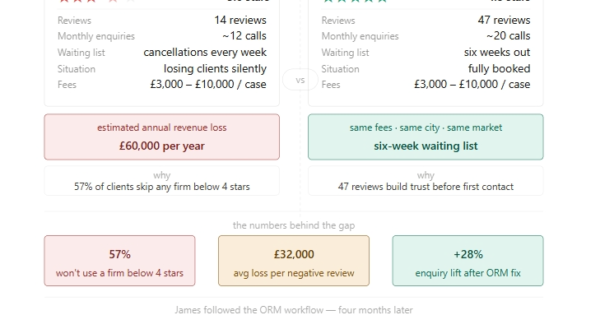
A firm with 47 reviews averaging 4.6 stars is not seriously damaged by one 1-star review. A firm with 4 reviews averaging 3.8 stars, however, is devastated by it.
Sending a direct Google review link to satisfied clients within 48 hours of a positive engagement, consistently and systematically, builds the volume that changes the overall narrative over time. Research from Harvard Business School confirms that a one-star rating increase on Yelp alone correlates with a 5 to 9% increase in revenue. That means the compounding effect of review volume is real and measurable.
4. Suppression content campaign
Systematic content publication targeting the firm’s name combined with its practice areas and location progressively fills page-one positions. In practice, four to six well-optimised pieces of content over 90 days — a combination of website articles, LinkedIn posts, and guest contributions — is typically enough to displace a mid-authority negative result from the top three positions.
5. AI search monitoring
Finally, attorneys should check ChatGPT, Perplexity, and Google AI Mode for the firm’s name at least monthly. Note what each platform says, where the information appears to come from, and whether it reflects current practice areas, locations, and professional status. If the AI is describing an outdated specialty or referencing old information, entity signal work and a FAQ-structured bio page can correct the response within 4 to 8 weeks.
Online Reputation Management for Lawyers by Location
The principles of ORM for attorneys apply everywhere. That said, the competitive landscape varies significantly by market, and the opportunity looks different depending on where a firm practices. Here is what law firms in major US cities and internationally should know.
| Atlanta, GA | Large personal injury, criminal defence, and family law market. High concentration of solo and small-firm practitioners with thin GBP presence. Strong opportunity for suppression campaigns and review generation. |
| Houston, TX | One of the largest legal markets in the US outside New York. High volume of mid-size firms with outdated websites and low review counts. Medical malpractice and employment law are particularly strong ORM niches. |
| Dallas, TX | Fast-growing corporate and family law market. Many firms have claimed GBPs but have not optimised them. AI search visibility is low across the market; an early advantage for firms that build entity signals now. |
| Phoenix, AZ | Growing market with many newer practices that have not yet built a search presence. The Arizona Bar’s EO-19-0010 makes the confidentiality constraint particularly well-documented here. |
| Miami, FL | Bilingual market with high demand from both English and Spanish-speaking clients. AI search visibility in both languages is a meaningful differentiator for firms serving diverse client bases. |
| Charlotte, NC | Fast-growing legal market with lower ORM awareness than coastal cities. Banking, real estate, and employment law firms are underserved. |
| Nashville, TN | Expanding legal sector with strong demand in entertainment, real estate, and personal injury. Most firms have not addressed their AI search presence. |
| Nairobi, Kenya | Growing market for advocates and law firms serving both local and international clients. AI hallucination is a significant risk for Kenyan advocates whose names appear in multiple contexts online. Very few ORM specialists in Kenya address the AI search dimension. |
| A one-star increase in a business’s Yelp rating correlates with a 5 to 9% increase in revenue, according to research from Harvard Business School. For a law firm generating $500,000 per year, improving from 3.6 to 4.6 stars represents a potential revenue uplift of $25,000 to $45,000 annually. |
| Source: Harvard Business School — The Value of Online Reviews |
Frequently Asked Questions
Can a lawyer respond to a negative Google review?
Yes, but only in a limited way. An attorney can acknowledge the review and state that professional obligations prevent a detailed response. What they cannot do, without risking a bar complaint, is disclose any information about the representation, even to correct a false claim. The Arizona Bar’s guidance is the most detailed available on this point: the recommended response is a generic statement noting that the review does not present a fair picture of events, without any specifics.
Can a negative review be removed from Google?
Only if it violates Google’s review policies. For example, if it contains hate speech, a clear conflict of interest, or is demonstrably not from a real client.
Genuine negative reviews, however unfair, generally cannot be removed. For that reason, the practical strategy is suppression. That means building enough authoritative content to push the review off page one, where the vast majority of searchers stop looking.
How long does ORM take for a law firm?
It depends on the authority of the negative content. For a review on a low-authority directory, the timeline is typically under 30 days. For a review on Google or Avvo, expect 60 to 90 days of consistent content publication and review generation.
For a news article or bar discipline record on a high-authority publication, however, the realistic timeline is 6 to 18 months. Every engagement should therefore begin with an audit that gives a realistic estimate based on the specific content and the firm’s current page-one position.
Does ORM work for solo practitioners as well as large firms?
Yes, and in many cases, solo practitioners see faster results because they have fewer competing presences to manage. A solo attorney’s name is their brand. As a result, owning 8 of 10 page-one results for that name is achievable within 90 days with a focused, well-executed campaign.
What does an ORM engagement for a law firm cost?
Reputableo’s services start with a free 8-area presence audit. Ongoing ORM retainers start at $600 per month and include content publication, AI monitoring, GBP management, and monthly reporting. Given the Harvard Business School research showing a 5 to 9% revenue uplift per star increase, the return on a properly executed campaign is typically measurable within the first 90 days.
Key Lessons for Attorneys in 2026
- Silence is not the only option. Confidentiality rules prevent a detailed response, but they do not prevent an online reputation management strategy.
- One negative review is a signal, not a verdict. Volume, authority, and recency all matter far more than a single result.
- AI tools are now part of how potential clients research you. As a result, what ChatGPT says about your firm is as important as what Google shows.
- Entity signals are the fastest path to AI search correction. In practice, schema markup, Wikidata, and consistent citations can shift AI responses within 4 to 8 weeks.
- The best time to build ORM for lawyers is before a problem appears. The second best time, however, is now.
| Not sure what Google or ChatGPT currently says about your firm? Reputableo offers a free 8-area presence audit covering your search results, AI platform responses, GBP, review profile, and entity signals. You will know exactly where you stand and exactly what to do about it. reputableo.com/contact | elisha@reputableo.com |
Not sure what Google and AI say about you right now?
I offer a free 8-area presence audit covering your search results, AI platform responses, Google Business Profile, and entity signals.
Get a Free Audit