| Quick answer: To build trust as a BBL surgeon, make your credentials, safety protocol, and outcomes verifiable. Claims like “zero risk,” “guaranteed results,” or “the safest BBL surgeon in Houston” create regulatory exposure and tell a skeptical patient nothing she can actually check. The most impactful approach is ensuring entity clarity. You achieve this by maintaining consistent credentials across every platform, answering hard questions transparently, and building search and AI visibility that reflects who you actually are. |
|---|
You already know your prospective patient reads your RealSelf reviews, cross-checks your board certification, and possibly asks ChatGPT what it knows about you before she ever picks up the phone to book a consultation. If you practice in a high-volume Brazilian Butt Lift surgery market like Miami, Los Angeles, Houston, Atlanta, London, Dubai, Istanbul, or Nairobi, she has probably checked out three or four of your competitors too.
BBL surgery carries a documented history of serious complications when performed with outdated technique. And your prospective patients know this before they contact you. That means when your marketing responds to their skepticism with superlatives, “safest,” “best,” “zero downtime,” it all sounds like the kind of overpromising they came online to screen out.
You’re Not Being Judged on Bedside Manner. You’re Being Fact-Checked.
Most plastic surgery marketing advice treats trust as a branding exercise: post more, respond faster, look more polished. None of that is wrong, but it misses what makes your category different in 2026.
Your prospective patients are not just evaluating tone. They are cross-referencing your board certification against state and specialty registries, checking whether the surgeon they spoke to in consultation is the surgeon who will actually operate, and reading complication and revision stories on RealSelf and Reddit before they read a word on your own site. In your category, trust is a verification problem before it is a rapport problem.
That changes what your marketing actually needs to do. You don’t want to sound more trustworthy than your competitor next door; you want to ensure the facts, your credentials, your safety protocol, and your patient history are easily verifiable from outside your own marketing.
| Roughly 45% of consumers now use AI tools like ChatGPT to research a provider before making contact, and 94% have avoided a business because of something they found online. Neither figure is specific to cosmetic surgery, but few categories carry higher research intensity before a purchase decision than yours. |
|---|
Why “Safest BBL Surgeon in [Your City]” Costs You More Patients Than It Wins
Running that line in your ad copy right now? It is worth understanding exactly what it costs you, on two fronts you may not be weighing together.
The first is regulatory. Claims like “zero risk,” “painless,” “guaranteed results,” or “the best BBL surgeon in Atlanta” are difficult to substantiate and almost cross the line the FTC’s endorsement and advertising guidance draws for health and medical claims. State medical boards apply similar scrutiny to advertising that implies an outcome you cannot promise to every patient.
The second cost is credibility, and it compounds. A patient who has already read three complication stories on RealSelf does not believe “safest surgeon in Houston” when she sees it on your site. She reads it as proof that you are not conscious about the risk profile of the procedure you perform. The line meant to build her trust does the opposite.
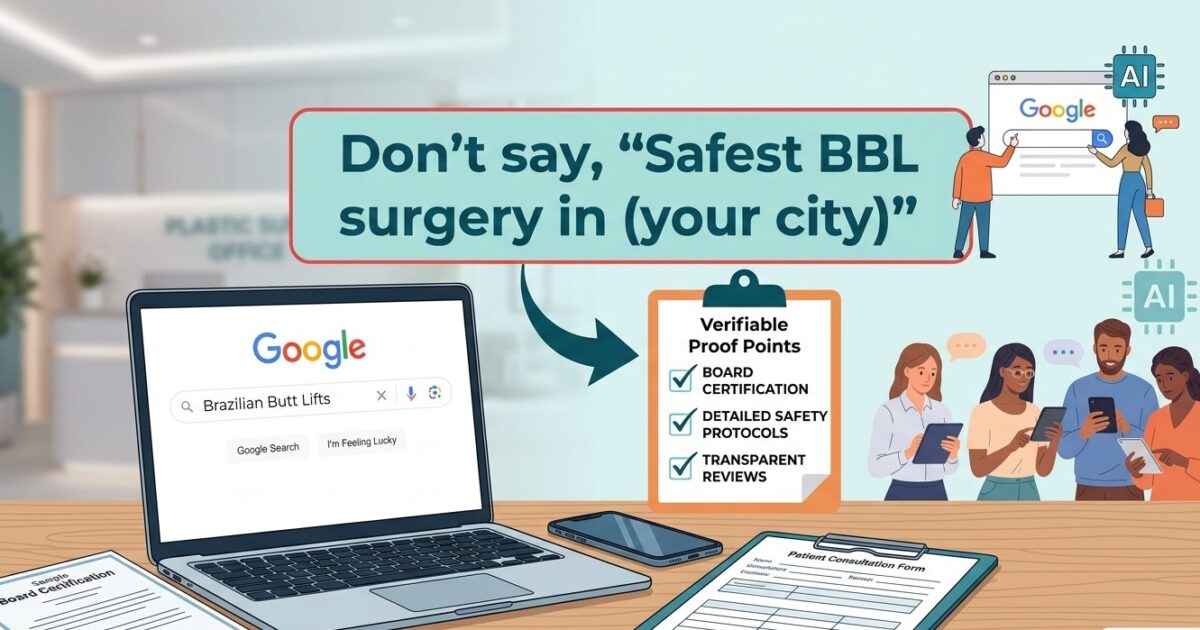
The fix is not softer adjectives. It is a different category of claim entirely, one built on things your patient can independently confirm without taking your word for it.
Five Trust Signals Your Patients Can Actually Verify
- Show your credentials. Don’t just name-drop them.
“Board-certified” is a claim. A direct link from your site to your listing on the American Board of Plastic Surgery or the equivalent national registry, alongside a clear statement of exactly which board certified you in which specialty, is a verification. Your patients increasingly expect the second, not the first.
2. Name the surgeon who will actually operate.
Ghost surgery, where the surgeon who consults is not the surgeon who operates, can adversely erode patient trust in the world of BBL. Stating plainly, in writing, exactly who performs the procedure removes a question your patients are actively trying to answer before they book with you instead of a competitor.
3. Describe your safety protocol in specifics, not adjectives.
“We prioritize safety” tells your patient nothing she can check. A description of your actual safety infrastructure, whether that is intraoperative imaging, anesthesia team credentials, or post-operative monitoring windows, gives her something concrete to evaluate. Route any clinical claim like this through your own sign-off before it goes live; this is your area of expertise, not your marketer’s.
4. Keep your review scores consistent across every platform.
Google, RealSelf, and Healthgrades ratings that agree with each other build more trust than a curated testimonial page on your own site. Suppose your ratings swing wildly between platforms, or you have a suspiciously perfect five stars with almost no review volume. Your patients see such a pattern as a red flag, not reassurance.
5. Publish what your consultation actually covers.
A plain description of your candidacy screening, realistic outcome ranges, and recovery expectations does more reputational work than another polished before-and-after gallery. It signals you are willing to say no to a patient whose goals are not a safe fit for her, which is precisely the judgment your prospective patients are trying to assess before they book.
| The pattern holds across professional services generally: content on page two of Google gets roughly 95% less visibility than page one, which means your own verified information has to actively out-rank directories, review aggregators, and patient forums you don’t control. |
|---|
What ChatGPT Says About You When a Patient Asks
Search engine optimization for cosmetic surgery is a mature discipline. Sadly, most plastic surgery marketing still ignores the AI layer, which is the fastest-growing way your patients now research a procedure this consequential.
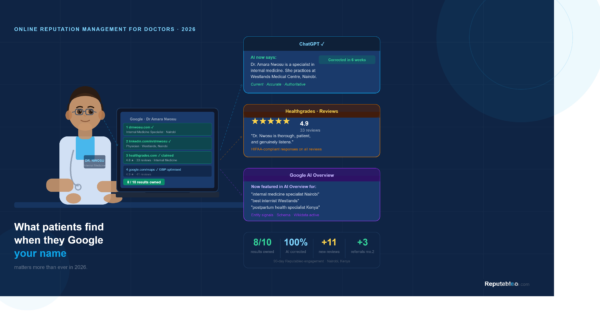
When a prospective patient asks ChatGPT or Perplexity to describe you, or to explain BBL safety standards generally, the AI tool draws its answer from whatever structured, credible signals it can find. This may include:
- Your own site
- Professional directories
- Board registries
- Third-party review platforms.
If those sources are thin, inconsistent, or absent, the AI fills the gap with generic information. In some cases, it confuses you with another surgeon entirely, a risk that rises in markets with fast-growing but less centralized directory data, including Dubai, Istanbul, and Nairobi.
In a category like BBL plastic surgery that already carries elevated safety scrutiny, an AI response that gets your credentials, specialty, or safety record wrong is not a minor inconvenience. It is a hallucination sitting in front of exactly the audience already looking for a reason to walk away from you.
You can fix this with Generative Engine Optimization (GEO), which corrects AI hallucinations for any professional. It entails:
- Person and MedicalOrganization schema markup identifying you and your practice precisely,
- Consistent credential data across every platform that ranks for your name,
- Monthly routine of checking what ChatGPT and Perplexity actually say, not just what Google shows.
Your Next Seven Moves
- Confirm your board certification is verifiable on an official registry and linked directly from your own site
- Audit your Google, RealSelf, and Healthgrades ratings for consistency; investigate any platform with an outlier score
- Remove or rewrite any advertising language implying guaranteed outcomes, zero risk, or superlative safety claims
- Publish a plain-language description of your consultation and candidacy screening process
- Implement Person and MedicalOrganization schema on your website
- Ask ChatGPT and Perplexity what they currently say about you by name, and correct any inaccuracies at the source
- Route every clinical or safety claim through yourself for sign-off before it goes live
Frequently Asked Questions
Can I legally call myself the “safest” or “best” BBL surgeon in my city?
Superlative claims of this kind are difficult to substantiate and carry real regulatory exposure under FTC advertising guidance and state medical board advertising rules, both of which scrutinize health and safety claims closely. Talk to healthcare advertising counsel before using superlative language, and in most cases a specific, verifiable claim will outperform a superlative one with patients regardless of the legal question.
Is online reputation management for BBL surgeons different than it is for other professionals Reputableo works with?
The core mechanics- search visibility, review management, entity signals, AI monitoring- are the same. The difference is stakes and scrutiny. Your patients research more intensively before booking, cross-reference more sources, and are more likely to be actively looking for a reason to disqualify you. That means your claims need to be more conservative and your verification signals more prominent than in most other professional categories.
Should I respond to negative reviews myself?
Yes, but carefully. A calm, professional response that does not confirm or discuss any specific patient’s treatment protects both your reputation and patient privacy. Never disclose protected health information in a public review response, even to correct a claim you believe is inaccurate.
Does AI hallucination correction work the same way for me as it does for other professionals?
The mechanism is identical: entity signals, schema markup, and consistent third-party citations correct what AI tools say about you. The stakes are higher in BBL cosmetic surgery, because an inaccurate AI description of your credentials or safety record reaches patients who are already primed to be cautious.
| Not sure what patients and AI tools currently find when they search your name or your practice? Reputableo offers a free 8-area presence audit covering your search results, AI platform responses, review consistency, and entity signals. reputableo.com/contact │ elisha@reputableo.com |
|---|
Not sure what Google and AI say about you right now?
I offer a free 8-area presence audit covering your search results, AI platform responses, Google Business Profile, and entity signals.
Get a Free Audit