| Quick Answer Online reputation management for doctors in 2026 means actively managing five surfaces: Google search results, AI tool responses (ChatGPT, Perplexity, Google AI Mode), healthcare directory profiles (Healthgrades, Vitals, Zocdoc), Google Business Profile, and patient review platforms. Because of HIPAA, doctors face public response constraints that no other profession faces, which makes proactive reputation building more important than reactive response. The goal is to own your page-one search results, ensure AI tools describe you accurately, and build a review profile strong enough that a single negative review cannot define your practice. |
A doctor had been practicing internal medicine in Nairobi for fourteen years. Her patient satisfaction scores were consistently high, her referral network was solid, and her Google Business Profile showed a 4.4-star average. Then she did something most doctors never do. She typed her own name into ChatGPT.
The result stopped her. ChatGPT described her as a general practitioner with a focus on family medicine. She is a specialist in internal medicine. It listed her as affiliated with a hospital she had left four years earlier. And it made no mention of her current clinic, which had been operating for three years in Westlands, Nairobi.
When she checked Perplexity, the results were similar. When she ran an incognito Google search to see what patients find when they Google a doctor in her position, she discovered an unclaimed Healthgrades profile with a rating she had never monitored sitting at position four in the results.
That audit took thirty minutes. It was among the most useful thirty minutes she had spent on her practice in years. This guide covers everything she learned from it and exactly what she did next.
Why Online Reputation Management for Doctors Is Different in 2026
Most professionals face a straightforward ORM challenge: controlling what appears when someone searches their name.
Doctors face that same challenge with an additional constraint specific to their profession. HIPAA prohibits confirming or denying that someone was ever your patient. That means you cannot dispute even a false, exaggerated, or malicious negative review in public without risking a privacy violation.
Suppose you’re in a competitive market like Houston, Atlanta, Los Angeles, Dubai, or London, where patients can choose from dozens of specialists with similar credentials. That constraint creates a significant asymmetry.
A patient can say anything publicly. A physician has to remain silent or risk regulatory exposure. As a result, the most effective ORM strategy for doctors is not reactive at all. It is proactive. You build a digital presence so strong that a single negative result cannot dominate your page one.
In 2026, that challenge has expanded well beyond Google. Patients increasingly begin their research by asking AI tools. What those tools say determines whether a patient proceeds to book or quietly moves on.
That means if you’re a doctor in New York, Dubai, or Nairobi, the AI layer is no longer optional to manage.
| 94% of patients consult online reviews before selecting a provider. 71% use reviews as their very first step when searching for a new doctor. |
The AI Problem That No ORM Guide for Doctors Is Talking About
Today, a growing share of patients is not just reading reviews. They are asking ChatGPT and Perplexity to describe a doctor before they ever open a review platform.
What those tools say about your specialty, hospital affiliation, and location is directly influenced by your online entity signals. If those signals are weak or inconsistent, the AI fills the gaps with whatever it finds in its training data, which can be years out of date.
For doctors in high-competition cities such as Atlanta, Houston, and Los Angeles, and for internationally based physicians in Dubai and London who serve English-speaking patients, this is not a theoretical risk. It is a documented operational problem.
ECRI ranks misuse of AI chatbots in healthcare as the number-one health technology hazard of 2026. It cites cases where chatbots suggested incorrect diagnoses, recommended unnecessary testing, and invented nonexistent anatomy.
| A 2026 BMJ Open audit found that 49.6% of AI chatbot health answers were problematic. Source: ECRI 2026 Health Technology Hazards Report (ecri.org) · BMJ Open, AI chatbot health information audit, April 2026 (bmj.com) |
For a doctor in Nairobi or Dubai, where Kenya ranks first globally and the UAE ranks second for ChatGPT adoption per capita, the stakes are particularly high. Patients in these markets are among the most active users of AI research in the world. They are asking ChatGPT about you. If ChatGPT says the wrong thing, they may not call.
Correcting what an AI tool says about you is not a matter of submitting a complaint form. It requires correcting the underlying entity signals, including:
- Your website schema
- Your Wikidata record
- Your Google Business Profile
- And your healthcare directory profiles
When those signals are accurate and consistent, AI tool responses update within four to eight weeks. For the full correction process, see the Six Steps to Correct Your ChatGPT Reputation Problem.
The Five Surfaces That Define Your Reputation as a Doctor
Online reputation management for doctors requires systematic attention to five distinct surfaces. Each reaches a patient at a different stage of their decision process, and a gap in any one of them creates an opening for a problem.
1. Google search results for your name
When a patient in Houston, London, or Dubai Googles your name, the first page of results is your reputation at a glance. For most doctors, that page includes a practice website, a LinkedIn profile, a Google Business Profile, a Healthgrades listing, and possibly a hospital or directory profile.
In practice, several of those positions are often occupied by outdated content, unclaimed profiles, or results for someone with a similar name. Each unoccupied position is open for something you did not put there.
2. AI tool responses
This is the surface most doctors are currently ignoring and the one where patient research is growing fastest. In 2026, patients routinely ask ChatGPT and Perplexity to describe a doctor before booking an appointment.
For physicians in cities like New York, Atlanta, and Los Angeles, where patient competition is intense, an inaccurate AI response can cost a referral before any human interaction takes place. For doctors in Dubai and Nairobi, where AI tool adoption is among the highest in the world, the same risk applies, with even greater frequency.
Beyond inaccurate specialty descriptions and outdated affiliations, the broader context matters here. When patients ask AI tools health questions, those tools frequently produce problematic answers.
A patient who has already been misinformed by AI about their own condition may then search for a specialist based on that misinformation and find your profile described incorrectly, too. Managing your AI layer is not just about accuracy. It is about being findable in the first place when patients are searching in the way AI is teaching them to search.
3. Google AI Overviews on health queries
Google AI Overviews now appear on a substantial share of health-related search queries. When a patient in Atlanta searches for a cardiologist, or a patient in Dubai searches for an English-speaking internist, they may see a synthesised AI-generated answer before any standard blue-link results.
Whether your practice appears in that answer and how it is described depend on the entity signals you have built around your name and specialty.
On top of that, when Google AI Overviews appear on health queries, organic click-through rates on standard results drop by roughly 61%, according to research by Conductor. That means patients are increasingly reading the AI-generated summary rather than clicking through to your website. If that summary describes a competitor more clearly than it describes you, the traffic difference compounds month over month.
4. Healthcare directory profiles
Healthgrades is the most widely used physician-specific review platform in the United States, with 60% of consumers starting their doctor search on Healthgrades. Beyond Healthgrades, Vitals, Zocdoc, and RateMDs each reach different patient segments, and each ranks in Google search results independently.
In the UK, NHS Choices and iWantGreatCare serve equivalent functions. In the UAE, platforms like Okadoc and DoctorUna are widely used by English-speaking patients searching for private healthcare providers in Dubai and Abu Dhabi.
Each unclaimed or incomplete directory profile is a position on your page one that you do not control. In addition, these directories feed data directly to AI tools. An outdated Healthgrades profile contributes to the entity signal confusion, which produces AI hallucinations about your specialty. Claiming and optimising your directory profiles is therefore both a review management step and an AI accuracy step.
5. Google Business Profile and review velocity
Your Google Business Profile is the single most important local reputation asset for most doctors, regardless of whether you practice in Houston, London, or Nairobi. It determines your visibility in Google Maps, your appearance in local search results, and the review summary that patients see before clicking anything else. A solo practitioner losing a single star on average Google rating can expect a five to nine percent drop in new patient bookings in a competitive market.
Review velocity matters as much as review volume in 2026. A practice with twelve five-star reviews from 2019 and no activity since reads as less active than a practice with eight reviews, four of which arrived in the last six months. A systematic post-appointment review request process, via a direct SMS link, is the most reliable way to maintain a healthy rating over time. SMS open rates in healthcare run above 90%, compared to roughly 25% for email, which makes it the most effective delivery method by a significant margin.
The HIPAA Constraint: A Practical Response Framework
Every guide about online reputation management for doctors mentions HIPAA. Most provide a template and move on. The problem with templates is that applying them without understanding the underlying framework creates the same risk they are meant to avoid. Here is the actual structure.
HIPAA prohibits confirming or denying that someone was ever your patient. A response that says ‘we are sorry your experience did not meet your expectations’ implies a patient relationship and creates legal exposure.
Even that level of specificity is too much. A compliant response does only three things:
- It acknowledges the concern in general terms.
- It directs the person to contact your office privately.
- It demonstrates professionalism without admitting, elaborating, or implying any clinical detail.
| HIPAA-compliant response framework: ‘Thank you for sharing your feedback. Our practice is committed to providing high-quality care to every individual we serve. We take all concerns seriously and would welcome the opportunity to speak with you directly. Please contact our patient care team at [phone or email] so we can address your concerns privately.’ What this response must never include: confirmation that the reviewer was a patient, any clinical detail, any reference to a date or visit, any language that implies knowledge of the specific situation. |
The real ORM work for doctors happens everywhere except in the response itself. The response is a damage-limitation step. The strategy that actually moves the needle is building enough review volume that any single negative review represents a small fraction of the overall signal. A practice in Atlanta with 47 reviews averaging 4.6 stars is functionally resistant to one bad review. A practice with 8 reviews is not.
A 7-Step ORM Process for Individual Physicians
Whether you’re a solo practitioner in Nairobi or a specialist group in Houston, this process applies equally well. The priorities below reflect the realities of a physician-led practice rather than a hospital marketing department.
Step 1: Run the complete audit first
Search your full name in an incognito browser. Search your name combined with your specialty and city. Then check ChatGPT, Perplexity, and Google AI Mode with the same queries.
Search your name on Healthgrades, Vitals, and Zocdoc. Document everything you find before making any changes. That map is your baseline, and every decision that follows is based on it.
Step 2: Claim and correct every directory profile
Claim your Healthgrades, Vitals, Zocdoc, and any specialty-specific directory profiles. Ensure your specialty, hospital affiliations, practice address, phone number, and professional photo are identical across every platform.
Inconsistency across platforms is the primary cause of AI hallucinations about doctors. Correcting it here begins correcting it in AI tool responses over the following four to eight weeks.
Step 3: Implement schema markup on your website
Add MedicalBusiness and Person schema markup to your practice website. These structured data signals tell Google and AI crawlers exactly who you are, what you specialise in, where you practice, and what credentials you hold.
Without this markup, AI systems build their understanding of you from whatever signals they find across third-party sources. Schema implementation takes two to four hours and is the fastest way to begin improving AI response accuracy.
Step 4: Claim and fully optimise your Google Business Profile
If your GBP is unclaimed, that is your highest-priority fix. Fill in every field, upload professional photos, set your correct categories, and add your website. Then implement a systematic review request process: an SMS with a direct GBP review link, sent to every patient within 24 to 48 hours of a positive appointment.
For physicians in competitive markets like Los Angeles, New York, or Dubai, where multiple specialists appear in the same local search results, a consistent stream of recent reviews is a meaningful differentiator.
Step 5: Respond to all existing reviews
Work through every existing review, positive and negative, using the HIPAA framework above. This signals to both patients and Google that your practice is actively managed and responsive.
For doctors in Nairobi and other East African cities, where patients are increasingly researching providers online before booking referrals, an active and responsive GBP profile is often the factor that determines whether an international patient chooses your practice over a competitor.
Step 6: Build thought leadership content targeting your name and specialty
Publish four to six well-optimised articles on your practice website targeting your name, specialty, and location together. A cardiologist in Houston should have content that explicitly connects those three terms consistently.
This content fills open page-one positions with owned assets and simultaneously strengthens the entity signals that influence AI tool responses. For guidance on pushing negative or uncontrolled content off page one, see how to push a negative Google search result off page one.
Step 7: Monitor all five surfaces monthly
Set up a monthly monitoring routine covering all five surfaces. An incognito name search. A ChatGPT and Perplexity check. A Google AI Mode check. A review count and rating check across all platforms.
A Google Search Console review for impressions on your name as a search query. This takes approximately thirty minutes per month and catches emerging problems before they compound into a full reputation incident.
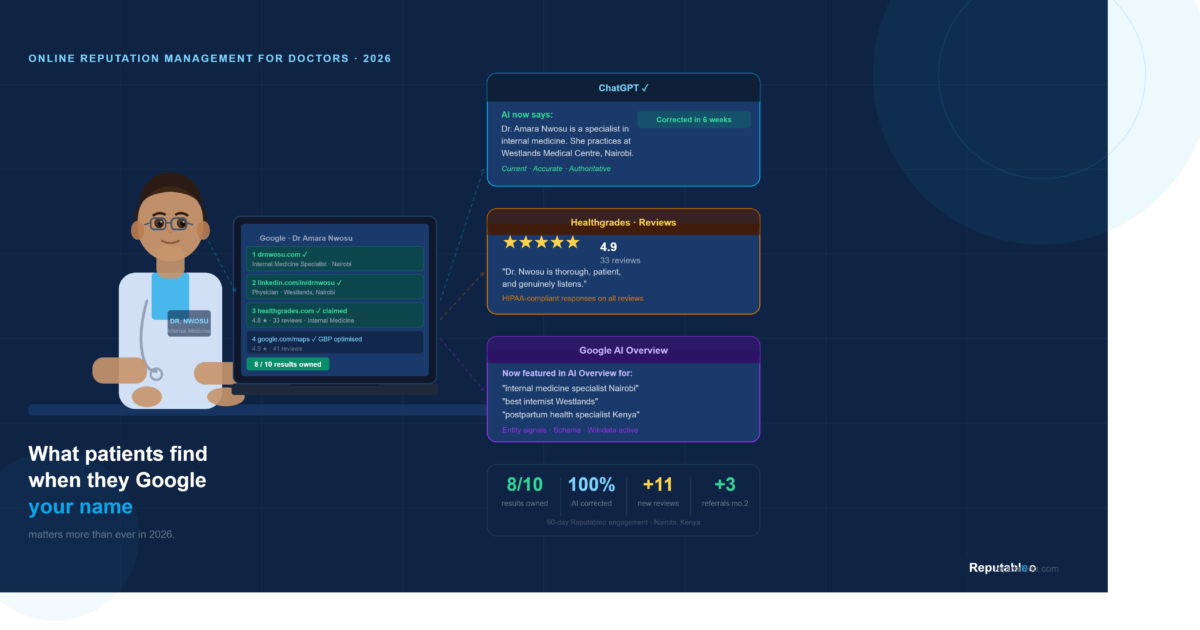
| Case study: Internal medicine specialist, Nairobi After a 30-minute audit revealed three AI platforms describing her inaccurately, an unclaimed Healthgrades profile, and 2 of 10 Google results owned, a doctor completed a structured Reputableo presence engagement. Within 8 weeks, AI responses across all three platforms had been corrected. Her Healthgrades profile was claimed and optimised. A review generation workflow delivered 11 new reviews in 6 weeks. Three new specialist referrals arrived in month two, compared to zero in the prior two months. |
Frequently Asked Questions
What do patients find when they Google a doctor?
A typical Google search for a doctor’s name returns a mix of owned results (practice website, LinkedIn), controlled results (Google Business Profile, Healthgrades, hospital affiliation pages), and uncontrolled results (old directory listings, outdated conference mentions, or negative reviews).
Most doctors own fewer than three of the first ten results. Each unoccupied position is open to something negative, outdated, or irrelevant to rank. In competitive markets like Houston, Atlanta, New York, and Dubai, where patients have many choices, those unoccupied positions are often filled quickly.
Can ChatGPT say wrong things about my medical practice?
Yes, regularly. ChatGPT, Perplexity, and Google AI Mode draw from training data that can be months or years out of date. For doctors, the most common errors are incorrect specialty descriptions, outdated hospital affiliations, and wrong practice locations.
ECRI ranked AI chatbot misuse as the number-one health technology hazard for 2026, in part because this misinformation reaches patients who have no reason to question it. Fixing it requires correcting the entity signals that AI systems draw from, including schema markup on your website, your Wikidata record, and your healthcare directory profiles.
How do I write a HIPAA-compliant response to a negative review?
Acknowledge the concern in general terms, direct the person to contact your office privately, and avoid any language that confirms, implies, or could be interpreted as acknowledging a patient relationship. Never reference a visit date, a treatment type, or any clinical detail.
The framework: ‘Our practice is committed to providing high-quality care to every individual we serve. Please contact us at [phone] so we can address your concerns privately.’ That is the full extent of what you can safely say publicly.
How do I handle a negative Healthgrades review?
First, claim your Healthgrades profile if you have not done so. Then respond with a HIPAA-compliant message using the framework above.
If the review violates Healthgrades’ content policies, which prohibit fake reviews, personal attacks, and content revealing protected health information, report it for removal. If the review is genuine but unfair, the most effective long-term response is building review volume through a consistent post-appointment request process. One negative review among forty-seven has a very different impact than one negative review among eight.
Do Google AI Overviews affect how patients find doctors?
Yes, significantly. When Google AI Overviews appear on health-related queries, organic click-through rates drop by roughly 61%, according to Conductor’s 2026 research.
Patients in Atlanta, Los Angeles, Dubai, and London who search for a specialist may read an AI-generated summary without clicking through to individual websites. If that summary describes a competitor more clearly than it describes you, those patients may never see your profile.
Building the entity signals that inform accurate AI Overviews, including schema markup, consistent NAP data, and FAQ-structured content, is the most direct way to improve your visibility on this surface.
How long does ORM take to produce results for a doctor?
Quick wins are visible within days: claiming an unclaimed GBP, responding to existing reviews, and correcting directory profiles. AI hallucination corrections typically propagate within four to eight weeks of entity signal work.
Building page-one ownership through systematic content publication takes three to six months for most solo practitioners. A review generation workflow producing consistent new reviews delivers a measurable improvement to your overall rating within sixty days of implementation.
In markets like Nairobi, Dubai, and Houston, where online reputation is increasingly the deciding factor in patient choice, that timeline is worth starting now rather than after a problem appears.
| Not sure what patients currently find when they search for your name? Reputableo offers a free 8-area presence audit for doctors covering Google results, AI platform responses (ChatGPT, Perplexity, Google AI Mode), Healthgrades and directory profiles, entity signals, GBP, and review profile. Whether you practice in Nairobi, Houston, Dubai, or London, the audit gives you a clear picture of where you stand and what needs to change. Delivered in 3 business days. No obligation. reputableo.com/contact · elisha@reputableo.com |
Not sure what Google and AI say about you right now?
I offer a free 8-area presence audit covering your search results, AI platform responses, Google Business Profile, and entity signals.
Get a Free Audit