| Quick answer: Search result suppression is the process of building enough high-quality, well-optimised content around your name or business that a damaging result gets pushed off page one to a page that almost nobody visits. It is the right strategy when removal is not possible, when the negative content is not defamatory, and when there are open page-one positions you can fill. It is not the right strategy when the negative content is justified. In that case, addressing the underlying issue always comes first. |
The Phone Call That Started This Article
Sarah is a management consultant. She spent seven years building a reputation that earned her referrals without trying. Then a former client left a scathing one-star review on a niche directory nobody had ever heard of, and Google decided it was worth ranking second for her name.
She called me with one question: “Can you remove it?”
The answer was no. The review was real. The client had genuinely had a bad experience. The platform had no removal policy for authentic reviews. And the content met no legal threshold for takedown.
What I told her instead changed how she thought about the whole problem. You do not need to remove it. You need to make it irrelevant. You need to fill the eight positions above it with content so strong that almost no one ever scrolls down far enough to find it.
That is search result suppression. This article explains how it works, when it is the right strategy, and critically, when it is not.
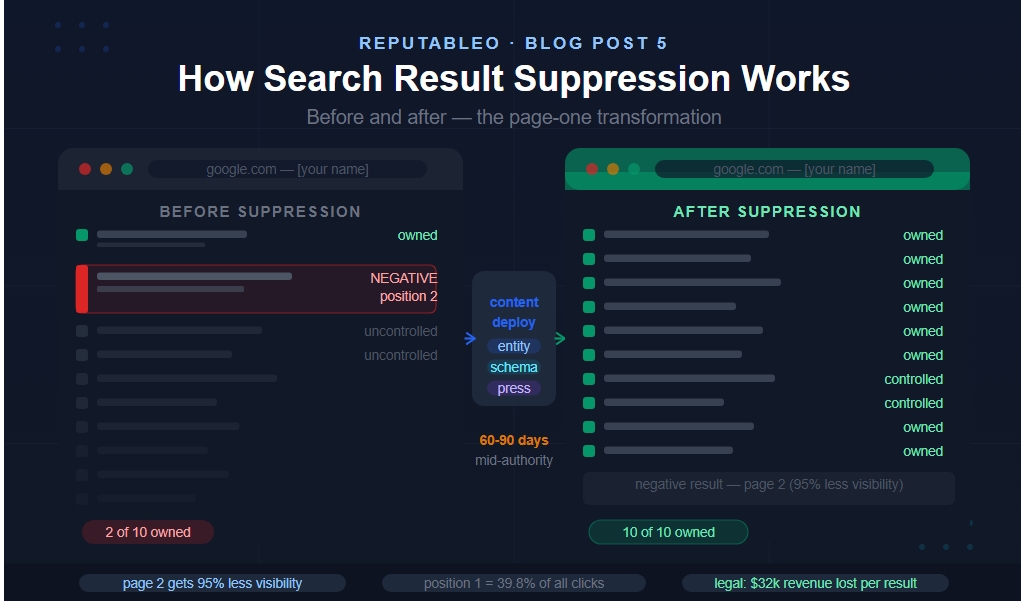
| Content on page two of Google receives 95% less visibility than page one results. The number one organic result receives 39.8% of all clicks. A single negative result in position one or two is reaching the vast majority of everyone who searches for you. Source: SE Ranking 2026 SEO Statistics / 2026 ORM Industry Report, Rephaven |
What Search Result Suppression Actually Is
Suppression is not removal. That distinction matters more than anything else in this article.
Removal means the content disappears from the internet entirely; taken down by the publisher, de-indexed by Google, or deleted following a legal request. When it is achievable, removal is always the better outcome.
The problem is that most negative content cannot be removed. It is real, it is factual, it was published by someone who had every right to publish it, and neither Google nor the platform has any obligation to take it down.
Suppression works on a different principle. Google has ten results on page one. Suppose you own or control nine of them. The tenth, however negative, is sitting at the bottom of a page that most people never reach.
Suppression does not make the content disappear. It makes the content functionally invisible to the overwhelming majority of people who search for you.
| 94% of consumers avoided a business because of negative online information. Over 90% of Google users never click past page one. The gap between page one and page two is not minor — it is the difference between being seen and being effectively invisible. Source: BrightLocal Consumer Survey 2025 |
How suppression actually works mechanically
Google ranks content based on authority, relevance, and engagement. The negative content ranking for your name is there because it has accumulated those signals, usually domain authority from a high-traffic review platform or news site, plus relevance from containing your name, plus engagement from readers clicking and spending time on the page.
To displace it, you need to build content that Google judges to be more authoritative and more relevant for that same search query. You do this by creating multiple pieces of well-optimised content across properties that Google already trusts, including your own website, LinkedIn, YouTube, press mentions, industry directories, and third-party publications.
Each piece targets your name or business name combined with your current professional context. Each piece earns its own position on page one, pushing everything below it down by one position.
A single negative result in position three requires you to fill positions one, two, three, four, five, six, seven, eight, nine, and ten above it to push it entirely off the page. That is why suppression takes months, not days. And why the timeline depends heavily on where the negative content currently ranks.
When Suppression Is the Right Strategy — And When It Is Not
This is the question most guides avoid. Not every reputation problem should be solved with suppression. The decision depends on six factors, as outlined in the table below:
| SITUATION | RIGHT STRATEGY | WHY |
| Negative content is accurate but outdated (old role, resolved dispute) | Suppression | Accurate content cannot be removed. But accurate old content can be outranked by accurate current content. |
| Negative content is unfair but not defamatory (vague negative review) | Suppression first, removal attempt simultaneously | Pursue removal through the platform if possible. Run suppression in parallel since removal may take months. |
| Negative content contains false statements of fact | Removal first, then suppression if removal fails | Defamatory content may qualify for legal takedown. Consult a lawyer before starting suppression. |
| Negative content is justified (real customer complaints, real problems) | Address the underlying issue first | Suppressing legitimate complaints without fixing the problem is a short-term mask. Fix the problem, generate new positive content, then suppress. |
| No negative content — just thin or absent page-one presence | Content building, not suppression | There is nothing to suppress. The strategy is proactive authority building. |
| High-authority news article (major publication, front-page story) | Long-term suppression (6-18 months) or legal/PR route | Major publications have enormous domain authority. Realistic timelines must be set before starting. |
| One question to ask before starting a suppression campaign: Is the negative content true? If the answer is yes and the underlying problem has not been addressed, suppression alone will not protect your reputation long-term. It will slow the damage while you fix the problem. Address the root cause first. Then build the content that replaces the narrative. |
How Long Does Suppression Take? A Realistic Guide
Every suppression guide gives a range of 30 to 90 days. That range is accurate but almost meaningless without context. Here is how to estimate your own timeline before committing to a campaign.
| Low-authority content: under 30 days | Forum posts, small directories, old social media profiles, thin blog posts from unknown sites. These are easy to displace because their domain authority is low. |
| Mid-authority content 60-90 days | Consumer review platforms (Trustpilot, Yelp, Glassdoor), regional news sites, niche publications. Require a sustained content campaign to displace. |
| High-authority content: 6-18 months | Major news publications, government databases, court records, national press articles. Some may never be displaced from position one. |
| Reddit threads: 30-90 days depending on upvotes | Active Reddit threads with significant engagement can be surprisingly persistent. Older, low-engagement Reddit posts displace quickly. |
How to Run a Suppression Campaign: The Step-by-Step Process
These steps apply whether you are a business, a consultant, a lawyer, or a doctor who is their own brand. The mechanics are the same even though the content type and platforms differ.
Step 1: Audit your current page-one landscape
Search your name or business name in incognito mode. Map every one of the ten results. Label each as owned, controlled, or uncontrolled. Note the authority of each.
Identify the negative content and its current position. This is your baseline, and every decision that follows is based on this map.
Step 2: Attempt removal in parallel
Before building any content, spend one week attempting to remove the negative content through every legitimate channel: report it to the platform for policy violations, check if it qualifies under GDPR right to be forgotten, contact the publisher directly if the content is outdated, and consult a lawyer if it contains false statements of fact.
Most attempts fail. But if removal works, it is the cleanest outcome.
Step 3: Identify which positions you can fill
Count your unoccupied or weakly occupied page-one positions. These are the positions you will fill with owned content. A realistic suppression campaign fills them from the top down; position one first, then two, then three, and so on until the negative content falls off the page.
Step 4: Deploy content across trusted properties
In 2026, the properties that earn page-one positions most reliably are:
- Your own website (home page and about page)
- LinkedIn profile and long-form articles
- YouTube (even short professional videos rank for name searches)
- Press mentions on relevant publications, industry directories and professional profiles
- Guest articles on authoritative sites.
Every piece of content should be optimised for your name combined with your current professional role and location.
Step 5: Implement entity signals alongside content
This is the step most suppression guides skip. Google and AI tools build their understanding of you from entity signals. These include schema markup, Wikidata entries, consistent NAP data across platforms, and linked professional profiles.
Strong entity signals help your owned content rank faster and also protect against AI hallucinations. Implement Person or Organisation schema on your website before publishing the first piece of suppression content.
Step 6: Build consistently and track monthly
Suppression is not a one-month project. It compounds. Each new piece of owned content adds authority.
Each month, run your incognito search and note which positions have shifted. A well-executed campaign typically shows first movement within 30 to 60 days and meaningful page-one displacement within 90 to 120 days for mid-authority negative content.
The 2026 Factor Nobody Else Is Talking About: Google AI Mode
Here is something critically important that almost no other suppression guide addresses in 2026.
Google AI Mode, launched at Google I/O 2026, generates full conversational answers to search queries without showing traditional blue-link results. When someone uses AI Mode to search for your name, Google does not show them a ranked list of pages. It generates a synthesised answer based on everything it understands about you from across the web.
This changes the suppression equation in one critical way.
Traditional suppression pushes negative content off page one in standard Google search. But if that negative content is part of Google’s knowledge about you, it may still inform what AI Mode says about you. That’s even after it has been pushed to page two in blue-link results.
A complete suppression strategy in 2026 therefore requires two parallel workstreams running simultaneously: page-one displacement through content deployment, and entity signal building to ensure Google’s AI systems understand who you are today, not who the negative content suggests you were.
| Google AI Overviews now appear in 25% of all Google searches. AI Mode is available to hundreds of millions of users globally following the Google I/O 2026 rollout. A suppression campaign that does not address AI visibility is incomplete. Source: Google I/O 2026 / Conductor Q1 2026 AI Overview Study |
What entity-signal building looks like in practice
- Implement Person schema on your website with sameAs links to your LinkedIn, Google Business Profile, and key professional profiles
- Create or update your Wikidata entry with current professional information
- Publish a FAQ-structured bio page that AI systems can parse directly
- Build consistent citations across authoritative professional directories so Google sees the same professional identity everywhere
- Monitor ChatGPT and Perplexity monthly, not just Google, to ensure AI platforms describe you using current, accurate information
Search Result Suppression for Individual Professionals
If you are a consultant, lawyer, doctor, or specialist practitioner whose personal name is your brand, suppression works slightly differently from a business context.
Businesses have marketing budgets, teams, and dozens of owned web properties. Individual professionals typically have a website, a LinkedIn profile, and a handful of directory listings. That means the page-one positions available to you are fewer, and each piece of content you build carries more weight.
| PROPERTY | RANKING SPEED FOR NAME SEARCHES | PRIORITY |
| Your website homepage | Fast — if properly optimised for your name | Build first. Ensure Person schema is implemented. |
| LinkedIn profile | Very fast — LinkedIn has enormous domain authority | Optimise headline and About section for your name + role. |
| Google Business Profile | Fast for local searches | Claim and verify. Fills a page-one position reliably. |
| YouTube video (professional intro) | Moderate — 30-60 days | Even a 3-minute professional introduction video ranks for name searches. |
| Guest article on authoritative site | Moderate — depends on publication authority | One strong bylined article in a relevant publication carries significant weight. |
| Wikidata and Knowledge Panel | Variable — 30-90 days for AI citation impact | Primarily impacts AI search results rather than traditional blue links. |
| Podcast appearance or mention | Slow — 60-120 days | Useful for volume of mentions but not reliable for rapid displacement. |
| Legal services lose an average of $32,000 in revenue per negative review. Healthcare providers lose $47,000 per negative review. For individual professionals in these fields, a single negative result on page one can cost the equivalent of a full monthly retainer every week it remains visible. Source: 2026 ORM Industry Report, Rephaven — analysis of 15,000+ business cases |
Frequently Asked Questions
How long does search result suppression take?
For low-authority content such as forum posts and small directories: under 30 days with a focused campaign. For mid-authority content on consumer review platforms or regional news sites: 60 to 90 days. For high-authority content on major national publications or government databases: 6 to 18 months of sustained effort. The specific timeline depends on the domain authority of the negative content and how many page-one positions you currently own.
Can I do search result suppression myself?
Yes, for mild cases involving low-authority content and where you already have a website and LinkedIn profile you can optimise. A professional earns meaningful page-one displacement faster because they can simultaneously run a content cluster, pursue guest article placements, and implement entity signals while tracking progress in Search Console. For mid-authority or high-authority negative content, professional help is usually the faster and more reliable path.
Will suppression work if the negative content is from a major news site?
It is the hardest type of suppression and the one with the longest timeline. Major news publications have domain authority that individual profiles and blog posts cannot easily exceed.
A realistic campaign for a major publication article typically takes 6 to 18 months, and it requires a combination of high-authority press coverage, guest articles on comparable publications, and YouTube or podcast content. Some high-authority news articles are never fully displaced; the realistic goal is to own positions one through eight so that the news article sits at nine or ten.
Does suppression fix what ChatGPT or Google AI Mode says about me?
Not automatically. Traditional suppression pushes content off page one in blue-link Google search results. Google AI Mode and ChatGPT build their responses from entity signals and training data, which can include content regardless of its current ranking position.
A complete 2026 suppression campaign requires parallel entity signal work, including Person schema, Wikidata entry, FAQ-structured bio page, and consistent professional citations, to ensure AI systems describe you accurately.
What is the difference between suppression and reputation management?
Suppression is a tactic within the broader discipline of reputation management. Reputation management covers the full spectrum: proactive authority building, review generation, crisis response, AI visibility, and suppression when needed.
Suppression specifically addresses the displacement of negative content from page-one search results. It is the right tactic when negative content already exists and ranks, not as a substitute for the broader work of building a strong online presence from the ground up.
The Bottom Line
Search result suppression works. It is not a guarantee, it is not instant, and it is not a substitute for fixing the underlying problem when the negative content is justified.
But for the majority of professionals dealing with outdated, unfair, or disproportionate negative content on page one, a well-executed suppression campaign combined with modern entity signal building is the most effective tool available.
In 2026, that campaign also needs to address Google AI Mode, ChatGPT, and Perplexity. After all, these platforms are now part of how potential clients research you, and pushing a result to page two in traditional Google search does not automatically clean up what AI systems say.
Start with an ORM audit. Know exactly what you are dealing with before you commit to a strategy. Then build consistently.
| Not sure what is on your page one — or what AI platforms say about you? Reputableo offers a free 8-area presence audit covering your search results, AI platform responses, entity signals, and page-one ownership. You will know exactly where you stand and what the right strategy is for your situation. Get your free audit by visiting reputableo.com/contact today! |
Not sure what Google and AI say about you right now?
I offer a free 8-area presence audit covering your search results, AI platform responses, Google Business Profile, and entity signals.
Get a Free Audit