| Quick Answer To push down negative Google results off page one, you need to outrank them with enough high-quality, well-optimised content so they drop to page two or beyond, where almost nobody looks. The process involves auditing your current page-one landscape, attempting removal in parallel, filling open positions with owned content, building entity signals, and monitoring progress monthly. For individual professionals, this typically takes 60 to 120 days for low-to-mid-authority content. In 2026, a complete strategy must also address what Google AI Mode and ChatGPT say about you independently of standard search results. |
Sarah is a financial consultant. She built her client base through referrals, workshops, and a reputation earned over eleven years. Then, during a routine check, she typed her name into Google in an incognito window and found something she had never seen before.
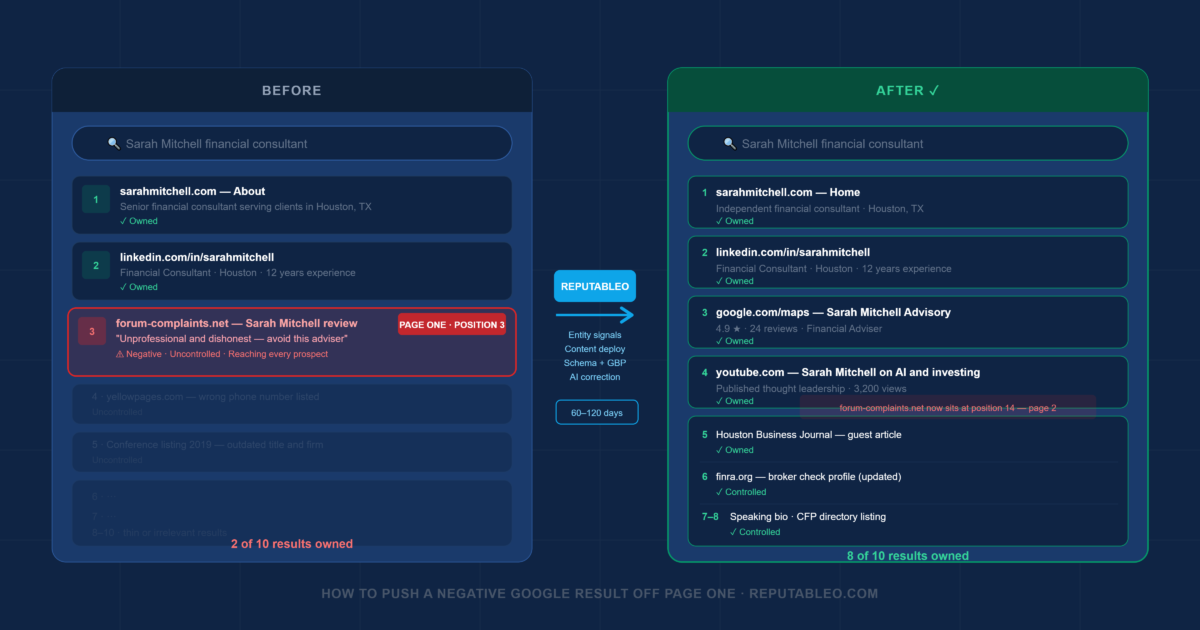
In position three, ranking just below her website and LinkedIn, was a two-year-old forum thread. A disgruntled former client had posted a vague but damaging complaint. It had accumulated enough engagement to rank, and it had been quietly sitting there, visible to every prospective client who searched her name, for twenty-four months!
She asked me the question I hear most often, “Can you just remove it?”
In this case, no. The content was real. The platform had no removal policy for authentic complaints. And the post met no legal threshold for a takedown request. As a result, the only viable path was to push down negative Google results by outranking the thread with content so strong that almost no one would scroll down far enough to find it.
That is what this guide is about. Not legal tricks. Not technical loopholes. Just a clear, step-by-step process that any professional can follow.
Why a Single Result on Page One Matters So Much
Most people never go past the first page of Google results. According to First Page Sage’s 2026 CTR analysis, the top organic result receives approximately 39.8% of all clicks on a clean search results page. By position ten, that number drops to under 2%. Content sitting on page two receives a fraction of a percent of total clicks.
For professionals, this math is stark. A negative result at position three means it is seen by a significant share of people who search your name. At position five, still substantial. At position ten, still visible to a meaningful number of people. Off page one entirely, it becomes functionally irrelevant to almost everyone who looks you up.
That is the entire logic of suppression: invisibility is operationally identical to deletion for the vast majority of your prospective clients.
Suppression vs Removal: The Decision You Need to Make First
Before starting a suppression campaign, it is worth spending one week on removal attempts. The reason is simple: if removal works, it is a better outcome than suppression. The content disappears entirely, rather than being buried under material you have to keep producing.
Removal makes sense in these cases:
- When the content violates the platform’s own policies,
- Contains demonstrably false statements of fact that meet a legal threshold,
- Qualifies under GDPR’s right to erasure (primarily for professionals in the UK and EU),
- Or it was posted by someone who is willing to take it down voluntarily upon request.
Suppression is the right path when removal fails, which it will in most cases. That is because most negative content is real, factual, and legally published. Thus, neither Google nor the platform hosting it has any obligation to remove it.
In those cases, suppression is not a fallback. It is the primary strategy. For a deeper look at how to choose between the two, see [Post B4: Search Suppression vs Removal].
The 7-Step Process to Push Down Negative Google Results
This process is designed for individual professionals rather than large organisations. The mechanics are the same either way, but the available assets and realistic timelines differ. A solo consultant has fewer owned web properties than a business, which means each piece of content carries more weight, and the order of operations matters more.
Step 1: Run a full incognito audit
Open a browser in incognito or private mode. Search your full name and, separately, your name combined with your profession or city. Map every one of the first ten results. Label each as owned (you created it and control it), controlled (you did not create it but can update it, like a LinkedIn profile), or uncontrolled (created by someone else with no access for you). Note the current position of the negative result and the domain it sits on.
That map is your baseline. Every decision in the campaign that follows is based on it.
Step 2: Attempt removal in parallel
While you begin building content, spend a week pursuing removal through legitimate channels. Report the post to the platform for policy violations.
If the content contains false statements of fact, consult a lawyer about your options. Check whether the GDPR right to erasure applies if you are in the UK or EU. Contact the publisher directly if the content is outdated.
Most attempts will fail. But if one succeeds, it eliminates the need for suppression entirely.
Step 3: Identify which positions you can fill
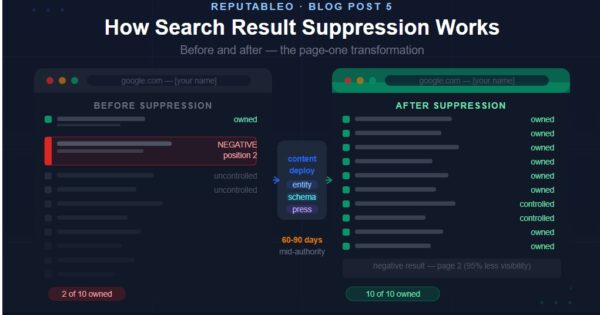
Count the unoccupied or weakly occupied positions on your page-one map. Those are the positions you need to fill with owned content. A realistic campaign works from the top down: fill position one first if you do not already own it, then two, then three, and so on, until the negative result falls off the page.
The number of positions you need to fill depends on where the negative result currently sits. If it is at position eight, you need to own positions one through seven to push it off page one entirely. If it is at position three, you need to fill two positions ahead of it and then maintain enough surrounding content that it keeps falling.
Step 4: Deploy content across trusted properties
In 2026, the properties that earn page-one positions most reliably for a professional’s name are their own website homepage and about page, their LinkedIn profile and long-form articles, YouTube videos (even a three-minute professional introduction ranks well for name searches), guest articles on authoritative industry publications, professional directory listings, and press mentions.
Every piece of content should target your full name combined with your current professional role and location. That combination is what Google matches against a name search. Without explicit location and role signals, content is less likely to rank for the specific query that triggers the negative result.
Step 5: Build entity signals alongside content
This is the step most suppression guides skip. Google and AI tools build their understanding of who you are from entity signals, not just from page content.
Those signals include:
- Person schema markup on your website
- A verified Wikidata entry with your current professional details
- Consistent NAP data across all directories
- sameAs links connecting your profiles
Strong entity signals help your owned content rank faster because Google can confirm you are a real, well-documented entity. They also protect you from AI hallucinations on platforms like ChatGPT and Perplexity, which can describe you inaccurately if your entity signals are weak.
If you are unsure what AI tools currently say about you, read this article about ChatGPT online reputation management.
Step 6: Address the AI layer independently
Here is a critical point that none of the other suppression guides currently address. Pushing a negative result off page one in traditional Google search does not automatically fix what Google AI Mode or ChatGPT says about you.
Google AI Mode, which launched at Google I/O 2026, generates conversational answers to search queries without showing traditional blue-link results. If a prospective client uses AI Mode to search for your name, they receive a synthesised response based on everything Google understands about you, including content that may be on page two or three of standard search results.
| In a February 2026 study, Ahrefs analysed 300,000 keywords and found that the presence of a Google AI Overview correlates with a 58% reduction in click-through rate for top-ranking pages. Source: Ahrefs, AI Overviews and Click-Through Impact Study, February 2026 (ahrefs.com) |
As a result, a suppression campaign in 2026 requires two parallel workstreams: page-one displacement through content deployment and entity signal building to ensure AI systems describe you accurately. The content strategy addresses what people find when they click. The entity signals address what AI tools say before anyone clicks.
Step 7: Track and defend monthly
Suppression is not a one-month project. It compounds over time, and it can reverse if you stop. Each month, run your incognito search and record the current position of every result.
Note which of your owned assets have moved up and which have stabilised. If the negative result begins climbing back, it usually means the content surrounding it has aged without being refreshed. A single new post or profile update is often enough to hold it in place.
Use Google Search Console to track impressions and clicks for your name as a search query. That data will tell you whether your suppression content is gaining traction before it shows up in manual position checks.
Realistic Timelines by Content Authority
Every suppression guide gives a vague range of two to six months. That range is accurate but unhelpful without context. Here is how to estimate your own timeline before committing to a campaign.
| Content type | Expected timeline |
| Forum posts, small directories, old social profiles | Under 30 days with focused content deployment |
| Consumer review platforms (Trustpilot, Yelp, Glassdoor) | 60 to 90 days of sustained content publication |
| Regional news sites and niche publications | 90 to 120 days with guest article placements |
| Reddit threads with significant engagement | 30 to 90 days depending on upvote count and age |
| Major national publications and government databases | 6 to 18 months of sustained effort; some may never fully displace |
The domain authority of the negative content is the single most important variable. A forum post on a low-authority domain displaces quickly because your own website, LinkedIn, and a couple of published articles already have more authority. A piece of coverage on a major news site has accumulated years of backlinks and trust signals that are very difficult to outweigh.
For lawyers, doctors, and other licensed professionals who face specific restrictions on what they can say publicly, the suppression strategy is the same, but the content mix shifts. Because these professionals cannot respond to specific client complaints in detail without risking professional conduct violations, their suppression content needs to focus entirely on building positive authority: thought leadership articles, published case studies (with appropriate anonymisation), speaking engagements, and directory listings.
| Case study: Consultant, Nairobi — 90 days A Reputableo client arrived with 2 of 10 page-one results owned and an AI hallucination active on three platforms. After a structured 90-day engagement covering entity signal building, schema implementation, content deployment across six properties, and GBP optimisation, she moved to 8 of 10 page-one results owned. AI responses were corrected on all monitored platforms within six weeks. Three new client enquiries arrived in month three compared to zero in the two prior months. |
What Not to Do
Three mistakes account for most suppression campaigns that stall or fail:
- Starting with content instead of an audit. Without a clear map of the current landscape, content gets deployed in the wrong order and fills positions that do not help.
- Stopping after the first visible improvement. A negative result that has dropped to position seven is still on page one. The campaign is not finished until it is off the page entirely and has stayed off for at least one month.
- Ignoring the AI layer. In 2026, pushing a result to page two in a standard Google search is no longer sufficient if that result is still informing what AI Mode and ChatGPT say about you. The entity signal work and FAQ-structured content that correct AI responses must run alongside the suppression campaign, not as an afterthought.
Frequently Asked Questions
How long does it take to push down negative Google results?
For low-authority content such as forum posts and small directories, under 30 days with focused content deployment. For mid-authority content on consumer review platforms and regional news sites, 60 to 120 days. For high-authority content on major national publications or government databases, 6 to 18 months of sustained effort. The specific timeline depends entirely on the domain authority of the negative content and how many page-one positions you currently own.
Can I push down negative Google results myself, without professional help?
Yes, for content on low-authority sites and where you already have a website, LinkedIn, and a Google Business Profile you can optimise. The process in this guide is fully self-executable. For mid-authority or high-authority negative content, professional help compresses the timeline significantly because an experienced ORM specialist can secure guest article placements and build entity signals faster than most individuals working alone.
Does suppression work if the negative result is from a major news site?
It is the most difficult type of suppression and carries the longest timeline. Major publications have accumulated domain authority that individual profiles and blog posts struggle to exceed. A realistic campaign for a major publication typically takes 6 to 18 months and requires high-authority press coverage, podcast appearances, guest articles on comparable publications, and sustained YouTube content. Some high-authority articles are never fully displaced. In those cases, the realistic goal is to own positions one through eight so the article sits at nine or ten, limiting its reach substantially.
Will suppressing a Google result also fix what ChatGPT says about me?
Not automatically. Pushing content off page one in traditional Google search does not update what ChatGPT, Perplexity, or Google AI Mode says about you. Those platforms build responses from entity signals and training data, which can include content regardless of its current ranking position. A complete 2026 strategy runs entity signal work, Person schema implementation, and an FAQ-structured bio page in parallel with the suppression campaign. For a full guide on correcting AI responses specifically, see this article.
What can a lawyer do if they cannot publicly respond to a negative result?
Lawyers and other licensed professionals who face confidentiality restrictions on public responses have the same suppression tools available to them. The content mix simply shifts away from direct responses toward authority-building: thought leadership articles targeting their name and practice area, optimised legal directory profiles, a fully claimed and reviewed Google Business Profile, and YouTube content. None of these requires any reference to the complaint or the client. They work by filling the surrounding positions with strong owned content, gradually reducing the negative result’s share of page-one visibility.
How do I know when suppression has worked?
Suppression is working when the negative result has dropped to page two and has stayed there for at least four consecutive weekly checks. It is complete when it no longer appears in the first twenty results for your name. Use Google Search Console to monitor impressions for your name as a search query. Monthly incognito checks are the most reliable way to confirm real-world position. Set up a Google Alert for your name to catch any new content that may require an early response.
| Not sure what is currently on your page one or what AI tools say about you? Reputableo offers a free 8-area presence audit covering your page-one results, AI platform responses, entity signals, Google Business Profile, and review profile. Delivered in 3 business days. No obligation. reputableo.com/contact · elisha@reputableo.com |
Not sure what Google and AI say about you right now?
I offer a free 8-area presence audit covering your search results, AI platform responses, Google Business Profile, and entity signals.
Get a Free Audit