| Quick answer |
| Online reputation management for professionals begins with knowing how to identify a coordinated fake review attack. A fake review can usually be identified by four signals appearing together: a brand-new reviewer profile, no other review history, no specific details about the service, and a cluster of negative reviews arriving in a short window. Documentation is the difference between a successful removal request and a failed one. This guide explains how to spot fake reviews, document them correctly, and build a review profile strong enough to resist coordinated attacks. |
The Tuesday Afternoon That Changed How Dr Siddiqui Thinks About Online Reputation Management
Dr Karim Siddiqui received four one-star Google reviews on a Tuesday afternoon. All four appeared within 90 minutes of each other.
He checked his practice management system, but none of those people were in it. Two of the reviewer profiles had been created that same day. One name matched someone who worked at a nearby competitor in Birmingham.
Interestingly, none of the reviews mentioned a specific treatment, a date, or any member of his dental team. He was fairly certain they were fake. His problem, however, was proving it.
He called Google support, who told him to flag the reviews. Three weeks later, nothing had changed.
This experience is one of the most common reasons professionals come to Reputableo for online reputation management help. In addition, it illustrates the central challenge with fake reviews: recognising them is usually straightforward, but removing them requires evidence, persistence, and the right process.
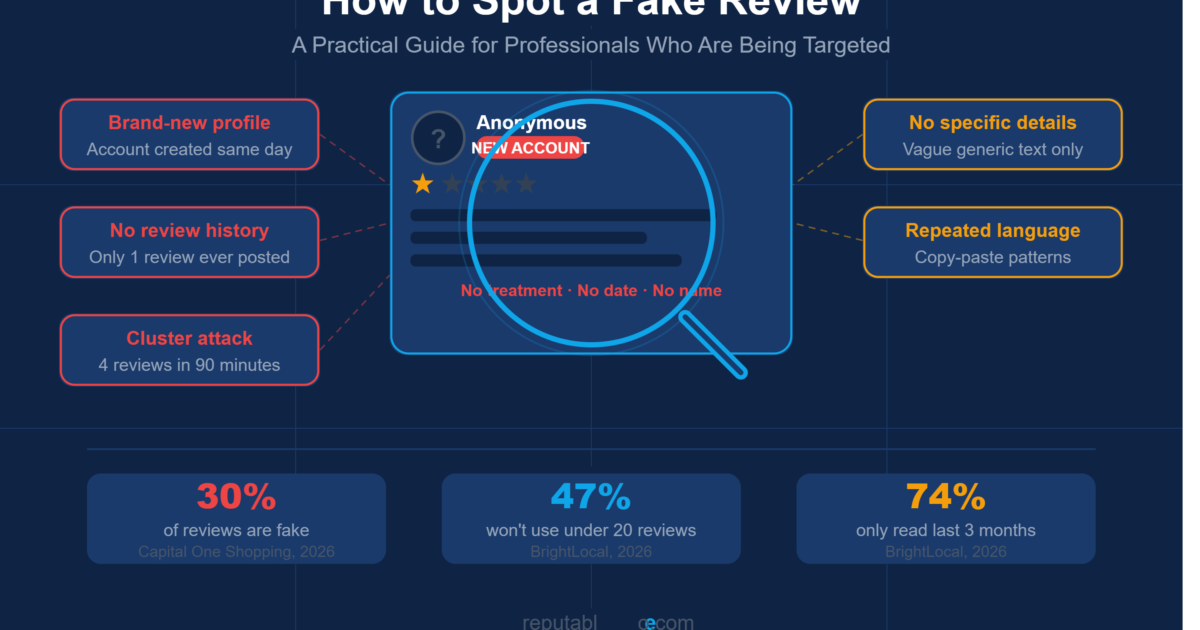
| 30% of all online reviews are now considered fake or inauthentic, representing roughly one in three. Beyond that, the number of fake reviews is growing 12.1% faster than the total number of genuine reviews each year. For professionals in competitive urban markets such as London, New York, and Dubai, coordinated negative review attacks have become an increasingly common tactic. |
| Source: Capital One Shopping, Fake Review Statistics 2026 |
Why Fake Reviews Have Become a Major Online Reputation Management Problem
Fake reviews are a growing online reputation management challenge across every professional sector. They come from competitors who want to reduce your market share. They also come from disgruntled former employees and, increasingly, from automated services that sell negative reviews in bulk online, often for as little as a few dollars per review.
The difficulty, however, is not recognising that a review might be fake. Most professionals can feel it immediately. The real challenge is documenting it clearly enough to have it removed, and building a professional reputation management strategy that protects you before the next attack arrives.
Where Fake Review Attacks Are Most Common
Fake review attacks are most concentrated in markets where professional competition is highest. In the UK, that means London, Birmingham, and Manchester, where medical, legal, and financial services practices compete in very tight geographic areas.
In the US, by contrast, the most affected cities are New York, Los Angeles, and Chicago. In the Middle East, Dubai is emerging as a significant fake review market, particularly in the cosmetic surgery and legal sectors. In East Africa, Nairobi is seeing a similar trend as more professionals build their practices around digital referrals.
In all of these markets, online reputation management services that include fake review monitoring and response protocols are no longer optional for professionals who depend on Google ratings to drive new client enquiries.
It is also worth noting the legal dimension. The UK’s Digital Markets, Competition and Consumers Act, which came into effect in April 2025, now explicitly bans fake reviews as an unfair commercial practice. Fines can reach 10% of global annual turnover for platforms that allow them.
Despite this, enforcement at the individual business level remains slow. As a result, professionals must know how to identify and document fake reviews themselves rather than relying on platforms to act.
Five Signs That a Review Is Probably Fake
You need to look at multiple signals together. No single signal is definitive on its own. However, when several of these appear at the same time, the case for removal becomes much stronger as part of your online reputation management process.
| Sign 1: The reviewer profile is brand new. If the account was created within days or hours of the review being posted, that is a strong signal. Most genuine patients or clients have Google accounts that have been active for months or years. In addition, brand-new accounts with no profile photo and a single review are a pattern Google’s own systems are designed to detect. |
| Sign 2: The reviewer has no other review history. Genuine reviewers usually leave other reviews for restaurants, shops, or services they use. A profile with only one review ever posted, in your professional category, is suspicious. Check the full profile carefully before drawing any conclusion. |
| Sign 3: The review contains no specific details. Genuine patients mention a specific treatment, a date, a member of staff, or a detail about the consulting room. Fake reviews, by contrast, are almost always generic: ‘Terrible service. Would not recommend.’ No procedure. No date. No name. That vagueness is a deliberate feature of fabricated content. |
| Sign 4: Multiple negative reviews arrived at the same time. A sudden cluster of negative reviews from different accounts within a short window is a classic sign of a coordinated attack. This pattern is particularly common in competitive urban markets such as London, New York, and Dubai. Document the timestamps carefully, as they are your most important evidence. |
| Sign 5: The language pattern repeats If two or more reviews use very similar phrasing or sentence structure, they may have been written by the same person or generated using the same template. Read them side by side and document the similarities. AI-generated fake reviews in particular tend to share structural patterns that become obvious on close reading. |
The Important Difference Between a Fake Review and an Unfair One
| This distinction is central to effective online reputation management. Confusing the two wastes significant time and effort. |
A fake review is one where the reviewer was never a patient or client. It is fabricated. It violates Google’s policies and, in the UK, it now violates the law.
An unfair review, on the other hand, is one in which the reviewer was a genuine client, but their description is inaccurate, emotionally charged, or lacks context. It may feel deeply unjust. However, it is not fake. Google will not remove it simply because you disagree with it.
Understanding this distinction saves a great deal of time. Do not spend weeks trying to remove an unfair review through Google’s fake review process. Instead, address unfair reviews through a professional response and a consistent review generation strategy. Save the formal removal process for reviews that are genuinely fabricated.
How to Document Fake Reviews Correctly
Documentation is everything in reputation management. Without it, your removal request will almost certainly fail. For that reason, follow this process in order before you submit anything to Google.
- First, take a screenshot of each suspicious review. Include the reviewer’s name, profile photo, star rating, and the date it was posted.
- Next, visit the reviewer’s profile. Screenshot their review history and the date their account was created. Note whether they have any other reviews or Google Maps activity.
- Then, check your own records. Can you confirm this person was never a patient or client? Search your CRM, booking system, and appointment records by name.
- Also, check whether the same account has left positive reviews for a competitor. This pattern is very useful evidence in a removal request and in any subsequent legal action.
- Finally, collect all documentation before you submit anything. Reference to which specific Google policy the review violates. The more specific your case, the better your chances of a successful outcome.
How to Report a Fake Review to Google
Go to your Google Business Profile. Find the review. Click the three dots next to it and select Report review. For a fabricated review, the most relevant category is usually Spam and fake reviews.
However, Google’s first response is automated. It often does not result in removal, even when your case is strong. As a result, if the automated review does not lead to removal within two to three weeks, escalate through Google Business Profile support. Request a live chat or phone callback. Be specific about which policy is being violated and reference the documentation you have collected.
| 47% of consumers will not use a business that has fewer than 20 reviews. In addition, 74% only consider reviews written within the last three months. This means review volume and recency are your most important defences against a fake review attack. A 4.8-star profile with 60 recent reviews is far more resistant than a 4.2-star profile with 12. |
| Source: BrightLocal Local Consumer Review Survey 2026 |
What to Do When Google Will Not Remove Them
This happens more often than it should. Even with good documentation, Google sometimes declines to act. When that happens, you have several options as part of your broader online reputation management strategy.
- First, respond professionally to the review. A response like this works well: ‘We have no record of treating a patient with this name. We take all feedback seriously and encourage anyone with a genuine concern to contact us directly.’ This signals to prospective clients that something is wrong without disclosing anything that could be used against you.
- Second, generate new genuine reviews from satisfied clients to suppress the negative ones. A 4.8-star rating with 60 reviews is far more resistant to a fake review attack than a 4.2-star rating with 12 reviews.
- Third, in cases of coordinated attack, consider seeking legal advice. In the UK, a solicitor’s letter citing the 2025 Digital Markets, Competition and Consumers Act sometimes produces results where a standard support request did not. This is especially relevant for professionals in London, Birmingham, and Manchester.
- Fourth, if you believe the attack is coming from a competitor, document the full pattern: positive reviews for the competitor from the same accounts, timing patterns, and linguistic similarities. This evidence forms the basis for a stronger legal claim.
How to Protect Yourself Before the Next Attack
The most resilient professionals combine strong documentation habits with a consistently growing review profile. Neither is sufficient on its own. Together, however, they make a coordinated fake review campaign much less likely to succeed.
- Set up a Google Alert for your name and your practice name. This gives you early warning of new reviews or mentions anywhere on the web.
- Check your review profiles weekly. The sooner you identify a fake review, the sooner you can document and report it, and the stronger your removal case becomes.
- Build your genuine review volume consistently. Ask satisfied clients for reviews immediately after a positive outcome. One fake review in a pool of 70 genuine ones has very little impact. The same review against a background of 8 genuine reviews, on the other hand, can be very damaging.
- Keep detailed records of all client interactions. Your appointment system, consultation notes, and communication history are your most important evidence when a fake review appears.
| Online reputation management is not only about fixing problems after they appear. For professionals in London, Birmingham, New York, Dubai, and Nairobi, the most effective strategy is one that makes you resilient before the next attack arrives: strong documentation habits, a consistently growing genuine review profile, and a proactive presence audit that tells you exactly where you stand across Google, AI tools, and the broader web. |
| Get a free 8-area online reputation management audit at Reputableo. We check your AI platform status, your review profiles, your page-one presence, and five other key areas. No commitment required. |
Not sure what Google and AI say about you right now?
I offer a free 8-area presence audit covering your search results, AI platform responses, Google Business Profile, and entity signals.
Get a Free Audit